A professional photographer chose to experience the solar eclipse with family instead of spending the short event concentrating on a technically perfect photograph. From the writer's location in the UK, the Moon covered about 91 percent of the Sun: not totality, but enough to transform the light around them.
The family's simplest viewing tool was a kitchen colander. Each small hole acted as a pinhole projector and cast its own crescent image of the partly covered Sun, repeating the eclipse across a pale surface without requiring anyone to look directly at the glare. Other observers used the same principle with pinhole cameras and colanders.
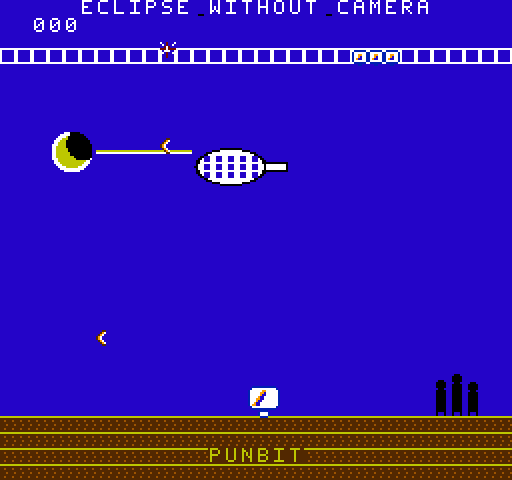
The issue is COLANDER, an original cartridge for the Nintendo Entertainment System, and it gives the reader the photographer's problem rather than his picture. You may not look at the Sun; you may only look at what it draws. The pad moves the colander over a garden, its images fall some way off because the Sun is off to one side and moving, and the pale sheet somebody laid on the grass is the only place in the garden where they exist at all -- which makes finding them a search rather than a drag. Four of the family are waiting their turn, and each is satisfied only by the deep crescent held steady on the cloth in front of them; slide off and their count goes back to nothing. B raises the camera, the one way to see the Sun itself, and it costs the seconds afterwards in which the sheet cannot be read. Show all four before the deep crescent goes and the shared view is complete; let it pass and somebody in the garden never saw it. Play it here in the browser, or download the ROM and run it on real hardware.