On September 28, SpaceX sent Starship into orbit for the first time. The Flight 14 mission released 26 third-generation Starlink satellites, giving the vehicle its first operational satellite payload. Spaceflight Now reports that one upper-stage engine stopped early during the climb, but controllers judged the spacecraft fit to complete another burn and reach orbit. After deployment, they shortened the mission. Rather than complete the planned six orbits, Starship returned after roughly three hours and splashed down in the Pacific north of Hawaii.
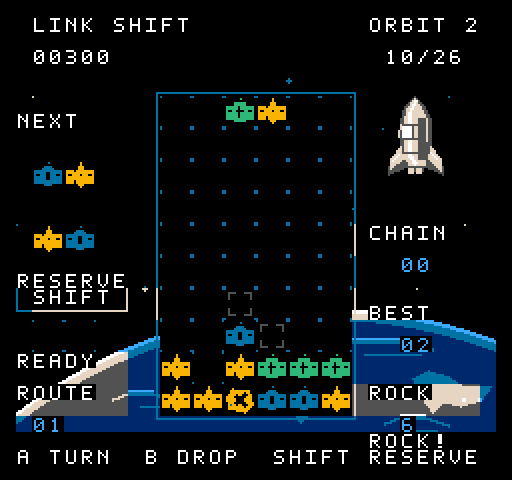
LINK SHIFT starts with those 26 satellites and gives you a six-column field to organise. They arrive in pairs, with three frequencies distinguished by colour and shape. Move and rotate each pair to connect at least four satellites of one frequency along their sides. The group disappears, everything above falls, and another match can start the next link in a chain. Two upcoming pairs are visible, a landing outline shows where the current pair will stop, and the reserve can hold one pair for later.
Twenty-six is the number of satellites placed in an orbit, not the size of a required match. At the checkpoint, press X to continue on the same field or Enter to bank your score and finish. Each new orbit falls faster. A single piece of debris arrives after the seventh pair on the first orbit; from the second orbit onward, one arrives every four pairs. Its column is shown in advance. Clear a neighbouring group to remove it. If a new pair or debris cannot fit, the attempt ends without banking its score.
There are up to eight orbits and 99 repeatable routes. Each chain link scores ten points per cleared satellite, multiplied by its position in the chain. Use the arrow keys to move, X or Up to rotate, Z to drop, Shift for reserve and Enter to pause. At the result screen, Z retries the route and Enter selects the next one. The grid, frequencies, debris and repeated orbits are puzzle rules invented for the cartridge. Play in the browser or download the NES ROM.