On September 23 Anthropic announced a biology lab of its own and a first result from it: a previously uncharacterized enzyme system in bacteriophages, the viruses that infect bacteria. The company calls it ART, for array-associated reverse transcriptase. The enzyme itself, which copies RNA into DNA, had been recorded before; what nobody had noticed was what sits next to it -- a long array of evenly spaced DNA repeats, and a partner gene with no known job. That layout is CRISPR's, and the array is what makes CRISPR programmable.
The search was run by software. Around 950 Claude agents spent 21 hours and 210 million tokens combing a public DNA database, gathered more than 200,000 reverse transcriptases, narrowed them to 3,500 new candidates and wrote up the 20 most promising for the scientists. One agent, reading the raw sequence beside an odd-looking enzyme from a jumbo phage, wrote that it could see a tandem repeat array by eye. It then counted the repeats, measured the gaps, compared the arrangement with known systems, searched the literature and filed a report for human review.
The caveats are in Anthropic's own account. The system's function is not yet known; CRISPR-like describes the arrangement, not a proven ability to edit DNA. Every experiment was performed by human scientists. Most candidates the agents propose are thrown out at review. And the company's chief executive noted that a Stanford team had earlier described a system that is in some ways similar. Feng Zhang, a pioneer of CRISPR genome editing, called the finding intriguing and worth further investigation.
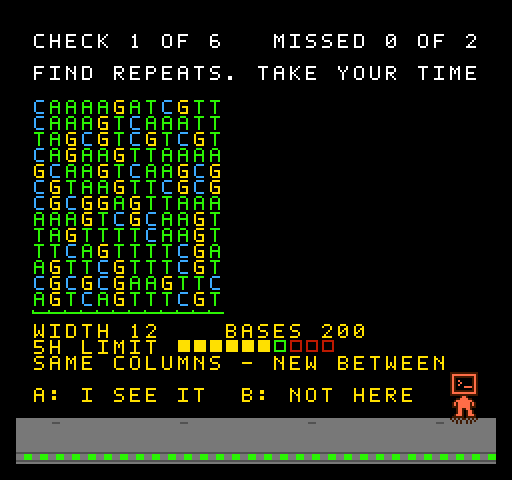
REPEAT OFFENDER, this issue's cartridge, hands you the agent's job. Two hundred letters of DNA sit on the screen; the arrows change how many fit on a line, and the letters reflow. Pick the width that matches the hidden step and the repeats stand in columns with new letters between them -- that is the array. Two impostors are there to be told apart by eye: a stutter, where every column stands because everything repeats, and fragments that recur at uneven steps and never line up. Five free practice pieces teach the difference; six shuffled pieces test it, and two misses end the run. The only budget is a five-hour limit that fills as you work and briefly puts the agent to sleep. Play it in the browser or download the .nes ROM.