A study of 26,811 secondary students in one county in central China followed them for 30 months, across nine subjects, as generative AI arrived in their homework. The tools worked in the way they were meant to: homework scores rose 18 percent, and the time spent on homework fell from 64 minutes to 45. The marks that came back from closed-book exams told a different story. Within six months they were down 20 percent, and the high-stakes entrance exams followed, 24 percent off the zhongkao and 18 off the gaokao.
The penalty took its time. David Stromberg, Victor Lei and Yanhui Wu report that the full effect on entrance results appeared only after about two years, long after the visible measure had improved. It also did not fall on everyone who used an assistant. Roughly four in five users showed the pattern the authors describe as outsourcing, homework finished unusually fast and scored unusually well, and the losses sit with that group. Students who kept their homework time close to that of non-users lost little.
What the paper does not say matters as much. It does not find that using an assistant is harmful in itself, it names no product, and it covers one county over one period rather than schools everywhere. The distinction it draws is between a tool that helps you work and a tool that does the work, and only the second one turns up half a year later on a paper you have to answer alone. The findings were published by CEPR in June 2026 and reached a wider audience through The Economist in August.
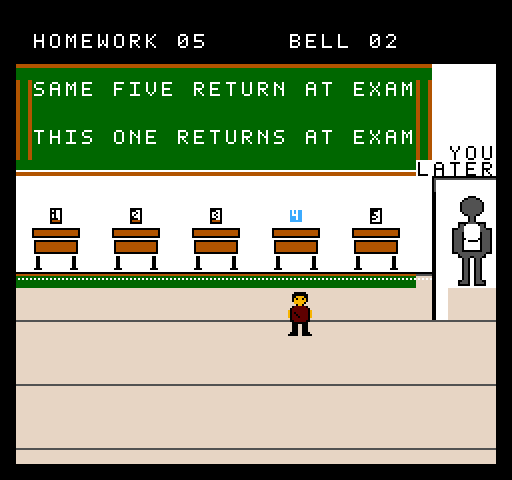
The issue is WHAT YOU KEPT, an original cartridge for the Nintendo Entertainment System. A corridor, five numbered questions and twenty seconds: holding A works one through and is worth one mark, tapping B hands it to the assistant and is worth two, and the day has room for four of the five. Then the bell rings and the exam asks the same five with the assistant gone. Play it in the browser, or download the ROM and run it on real hardware.