On October 5, Optica reported that Karl Deisseroth, Peter Hegemann and Georg Nagel had received the 2026 Nobel Prize in Physiology or Medicine for work on light-gated ion channels and optogenetics. Their research made light a way to control the activity of selected cells. The method depends on light-sensitive proteins: the cells must first be prepared to respond. A lamp pointed at an ordinary animal is not the same experiment. The distinction is essential to understanding what the award recognizes.
Hegemann and Nagel investigated channelrhodopsins, proteins that act as ion channels controlled by light. Deisseroth and his collaborators developed their use in neurons, allowing researchers to activate particular neural populations with precise timing. Optica describes applications in studying circuits associated with memory, emotion and behavior, as well as clinical research attempting to restore vision. These are experimental uses of targeted cellular control. The announcement does not turn the method into a general remote control for an animal.
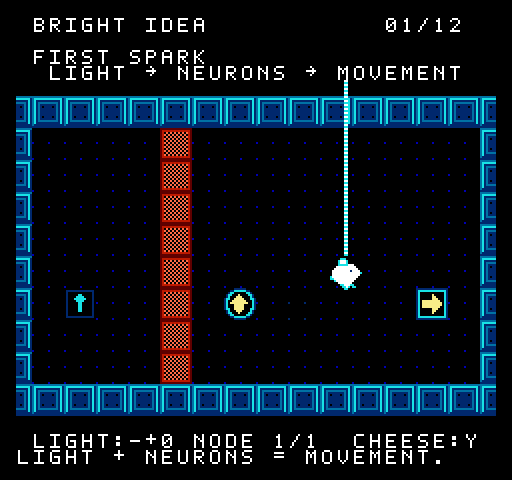
BRIGHT IDEA gives that connection a fictional, visible form: a beam reaches a laboratory mouse and starts a dash. The light runs out, so the next crossing depends on finding a recharge node or saving a reserve pulse. Twelve rooms put that decision among dangerous fields, breakable glass and moving guards. Every exit needs both its light nodes and its piece of cheese. The cheese also grants one extra pulse, making its position part of the route: collect it early to change direction during a dash, or save the extra move for a difficult crossing. Returning to a node restores the ordinary charge without consuming the reserve. A failed attempt restarts only its room. The mouse, escape, protective dash and cheese-powered reserve are inventions, not a description of an experiment. What the cartridge borrows is the causal chain: light changes neural activity, and that change produces an observable action.