On October 3, 2026, Donald Trump defended data centers supporting artificial intelligence at a campaign rally in Vandalia, Ohio. Associated Press reported that the projects had become a contentious election issue. Trump promoted his administration's approach, argued that communities should benefit and praised Senator Jon Husted's legislative efforts. That promise supplies this cartridge's starting question: what would a working arrangement look like for the buildings already there and the servers arriving beside them?
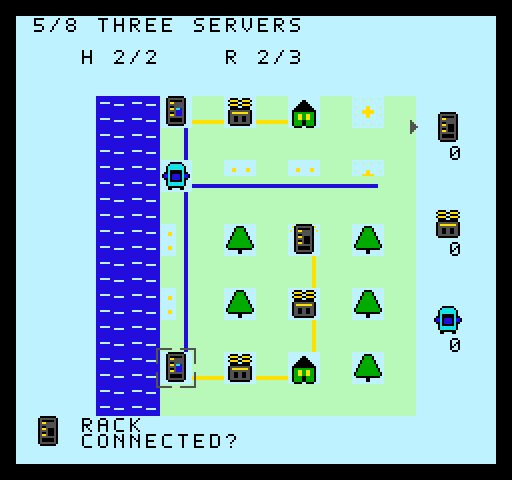
MAKE SERVERS GREAT AGAIN answers with a fictional town on a five-by-five board. Houses, trees, riverbanks and narrow passages divide the available space. You receive a small inventory of server racks, substations and pumps, then choose where each piece belongs. Every supplied server must be placed. Every house needs electricity, and every server needs electricity plus cooling water. A town with bright windows can still have an unfinished server. Yellow lights on a rack show power; a separate blue window shows water. Both must be on before that rack counts as ready.
The two networks follow different rules. A substation powers buildings directly beside it, never diagonally. A pump belongs beside the river and sends water in straight lines until a building or another obstacle stops it. An empty plot may therefore be useful as a route, while filling the same square can cut off a rack farther away. Existing buildings cannot be moved, and dotted passages must remain open. A good placement solves several needs at once; a promising placement can also reveal why another part of the board remains dark.
There are eight puzzles, with no countdown or failure screen. Move the cursor with the directional pad, use A to place or remove your own piece and B to change the selected type. Select undoes an edit; Start opens hints, restart and help. The final screen brings in Mayor Megawatt, a fictional satirical promoter in a red tie. The character, town layouts and supply rules are invented. They make a compact planning game, not an engineering model or a claim about the outcome of any actual Ohio project.